About · History of printing
Printing presses
through the ages.
From carved wooden blocks in ninth-century China to the digital presses of today, this is how printing changed the world, and the machines that made it happen.
Timeline
More than 1,150 years of print.
Every brochure, business card and poster we print today owes something to the people and machines below.
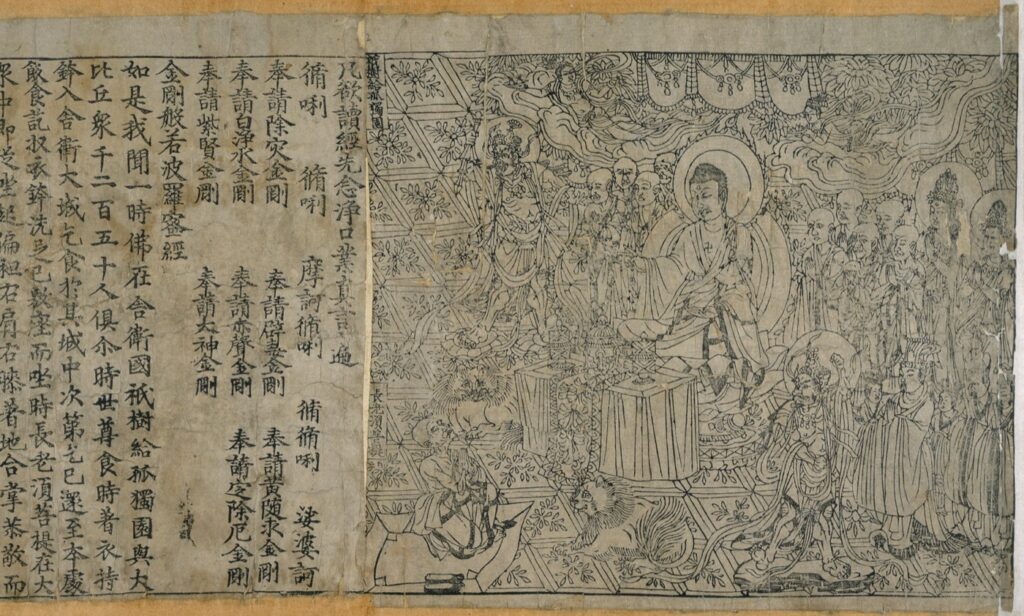
The Diamond Sutra, 868 AD. British Library. Wikimedia Commons (CC0).
868
Carved in wood
The oldest dated printed book in the world is the Diamond Sutra, printed in China in 868 from hand-carved wooden blocks. Every page was carved in reverse into a single block of wood, inked, then pressed onto paper. Around 1040 the Chinese printer Bi Sheng went a step further and made movable type from baked clay.
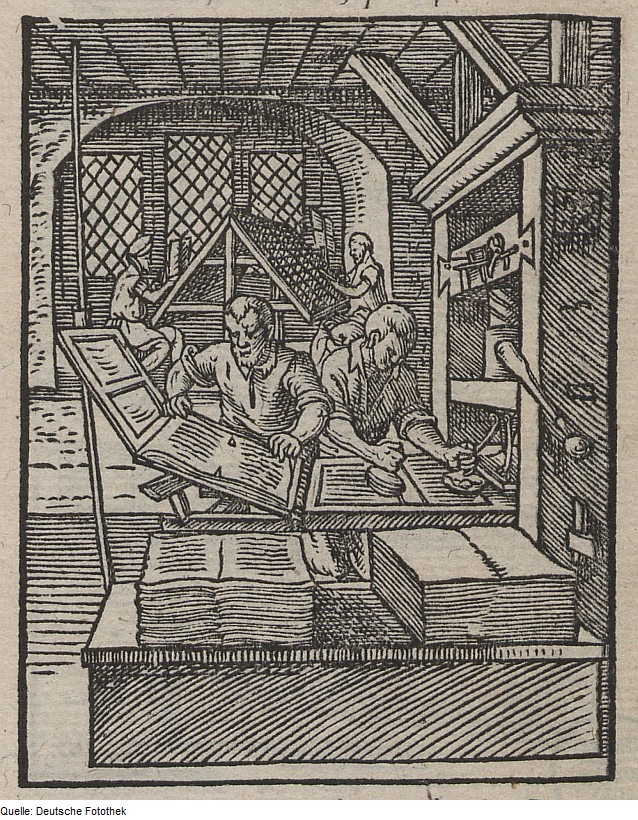
Jost Amman, The Printer, 1568. Deutsche Fotothek. Wikimedia Commons (public domain).
c. 1440
Gutenberg and movable type
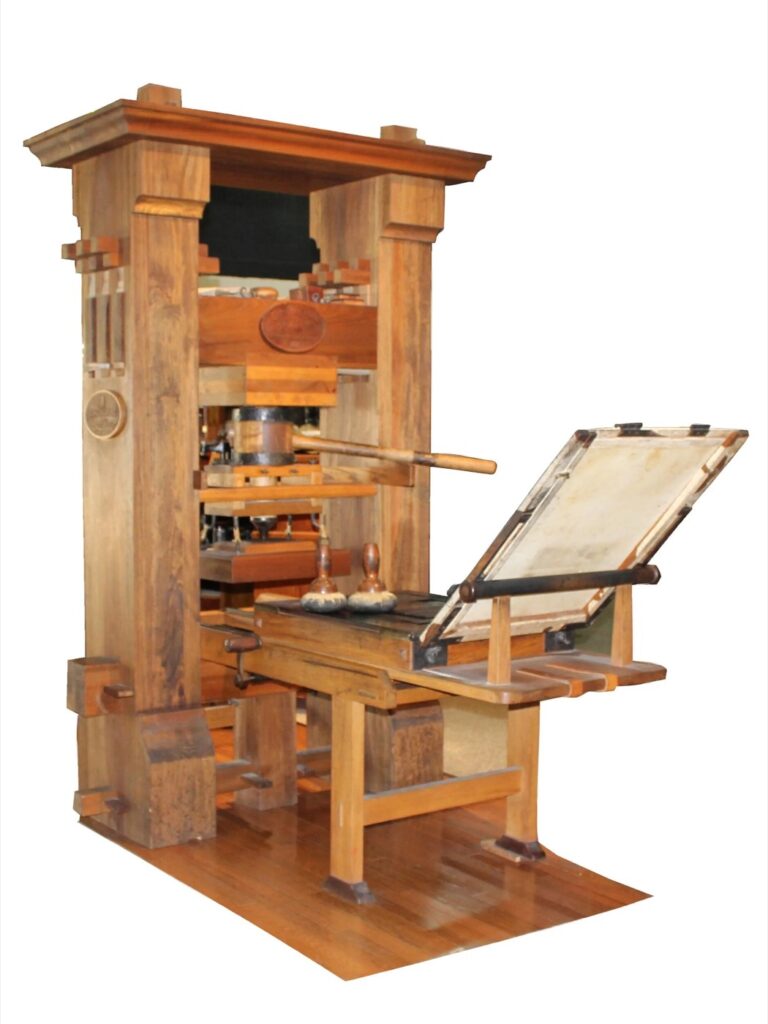
In Mainz, Germany, Johannes Gutenberg brought together metal type cast in moulds, an oil-based ink that stuck to metal, and a screw press adapted from wine making. His Bible, finished around 1455, proved books could be made by the hundred. Within fifty years there were presses in more than 200 European towns. In this 1568 woodcut, compositors at the back set type letter by letter while at the front one pressman inks the type with leather ink balls and another pulls the bar.
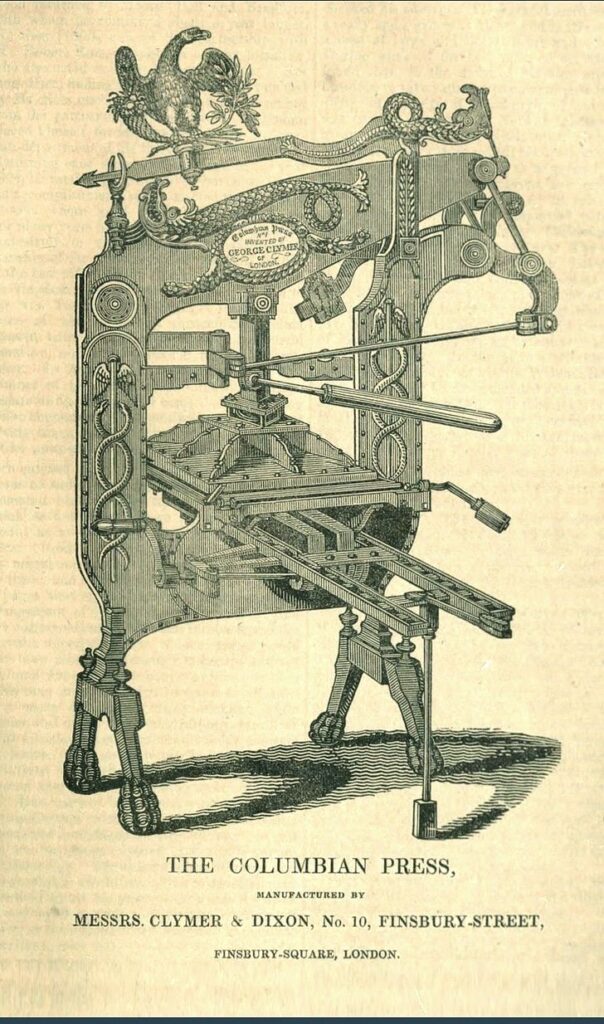
The Columbian Press, Clymer & Dixon, London. From Timperley’s Printers’ Manual. Wikimedia Commons (public domain).
1813
The iron hand press
Around 1800 the wooden press gave way to iron. The Stanhope press came first, then in 1813 George Clymer of Philadelphia built the Columbian, famous for the cast-iron eagle on top that doubled as a counterweight. Iron presses were stronger and gave a crisper print. Columbian and Albion hand presses printed country newspapers right across Australia.
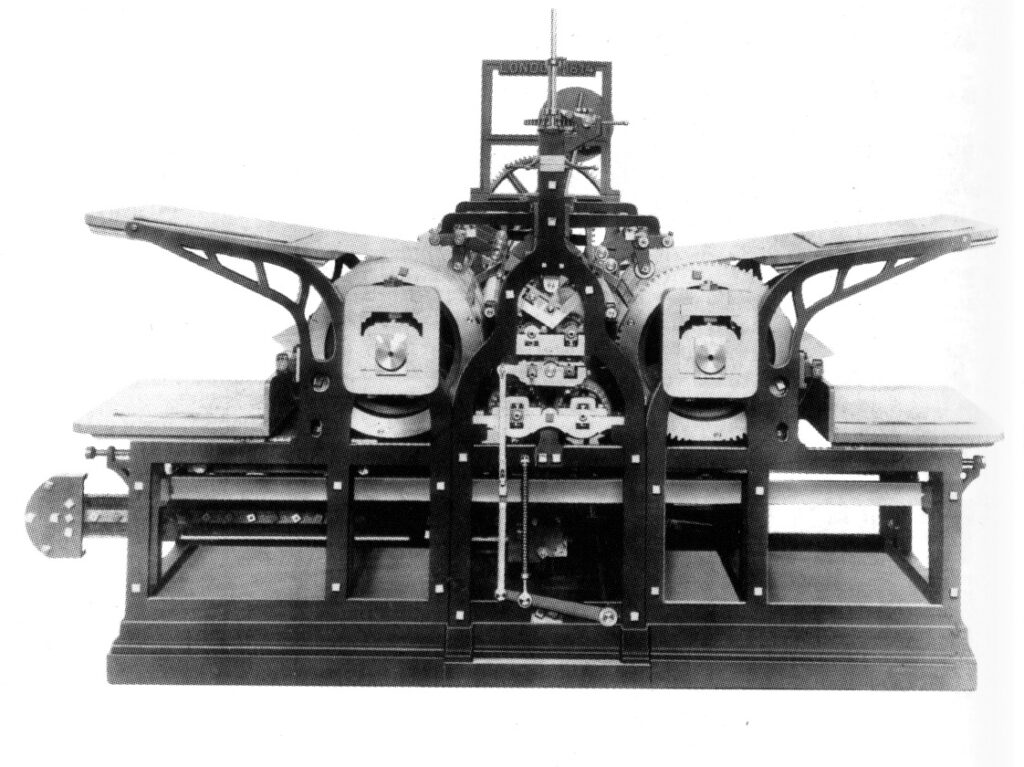
Koenig’s steam press, 1814. Wikimedia Commons (public domain).
1814
Steam power
On 29 November 1814, The Times in London was printed on Friedrich Koenig’s steam-powered cylinder press. Instead of a flat plate pressing down, a turning cylinder rolled the paper over the type. It printed about 1,100 sheets an hour, several times faster than the best hand press, and newspapers could reach far more readers.
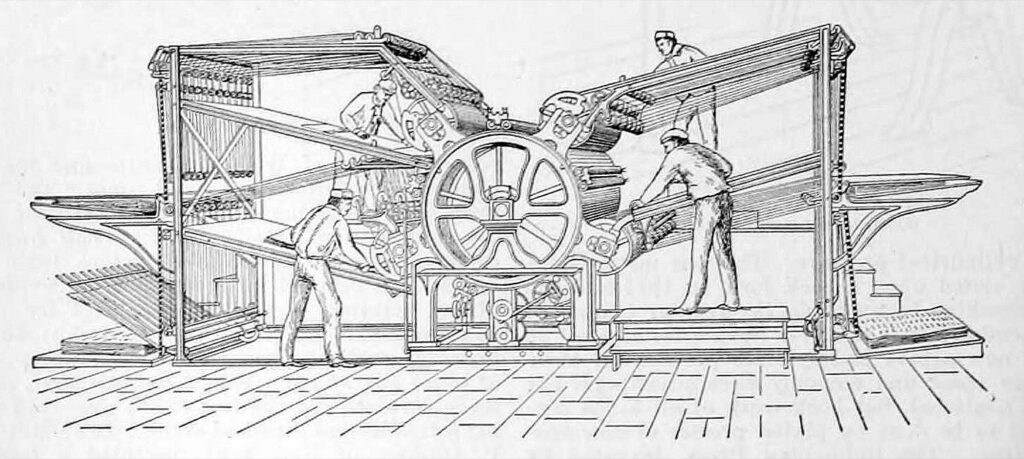
Hoe type-revolving press. New International Encyclopedia, 1905. Wikimedia Commons (public domain).
1847
The rotary press
Richard Hoe of New York locked the type onto a large revolving cylinder, with smaller cylinders feeding sheets around it. His “lightning press”, patented in 1847, printed thousands of sheets an hour. Later rotary presses printed from curved plates onto continuous rolls of paper, and the modern daily newspaper was born.
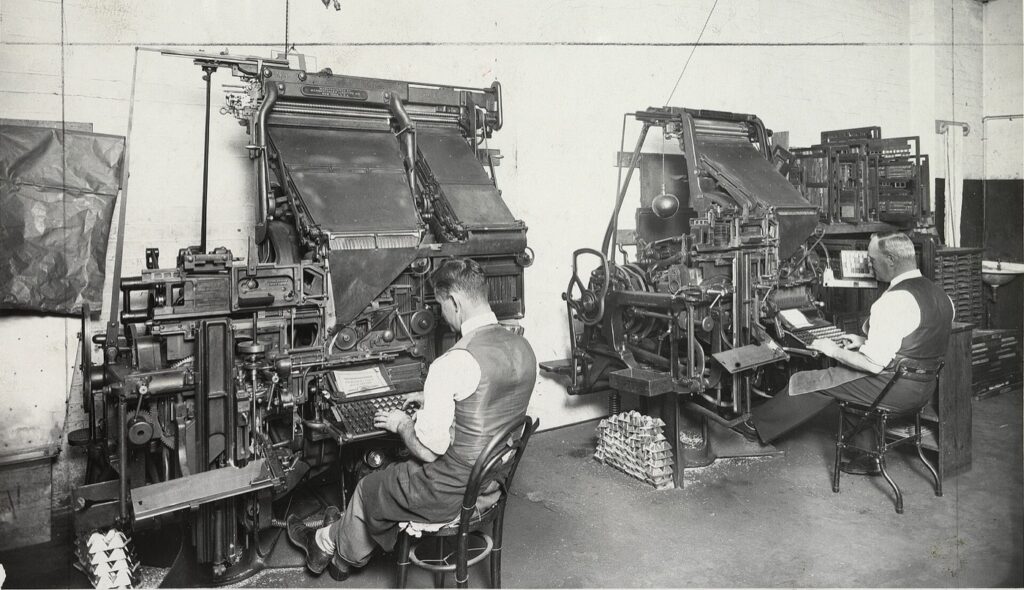
Linotype machines, Anthony Hordern & Sons, Sydney, c. 1935. Photo: A. E. Foster. Wikimedia Commons (public domain).
1886
Hot metal type
Setting type by hand was slow. In 1886 Ottmar Mergenthaler’s Linotype let an operator type on a keyboard and cast a whole line of type in molten metal at once. Linotypes set newspapers, books and magazines for the next 90 years. This photo shows Linotype operators at Anthony Hordern & Sons in Sydney around 1935.
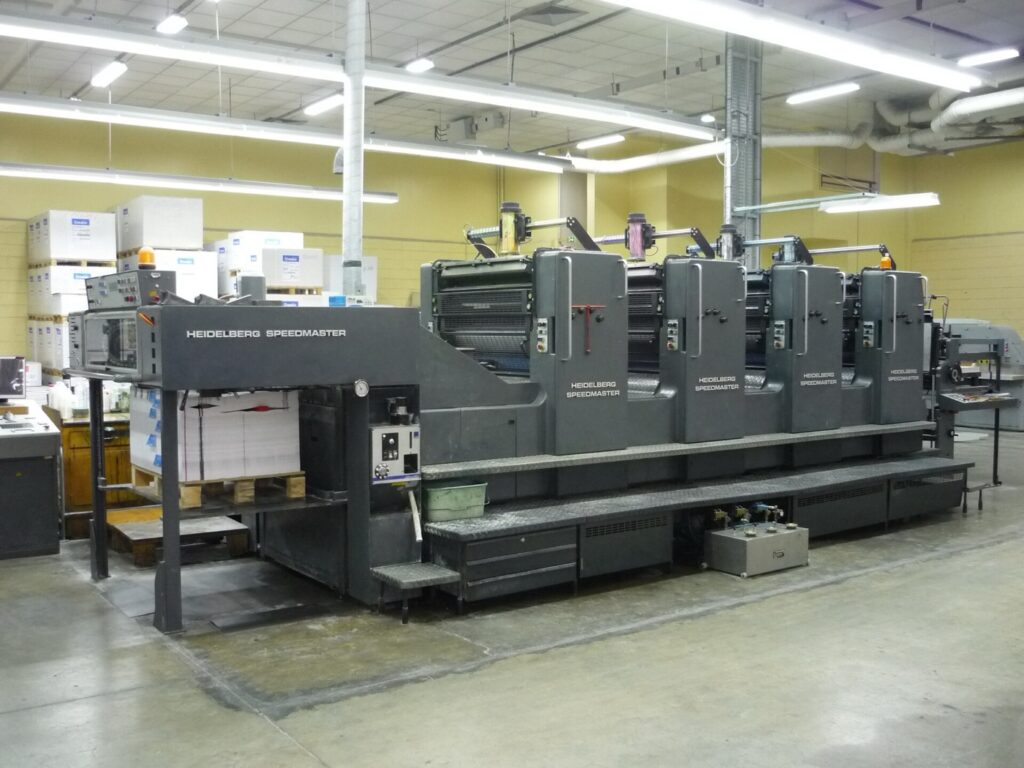
Heidelberg Speedmaster four-colour offset press. Photo: Rémih. Wikimedia Commons (CC BY-SA 3.0).
1904
Offset lithography
Lithography, invented by Alois Senefelder in 1796, prints from a flat surface using the simple fact that oil and water don’t mix. In 1904 Ira Rubel found that printing from the plate onto a rubber blanket, and then onto paper, gave a sharper result. Offset became the main way to print brochures, books and magazines, using four inks: cyan, magenta, yellow and black (CMYK).
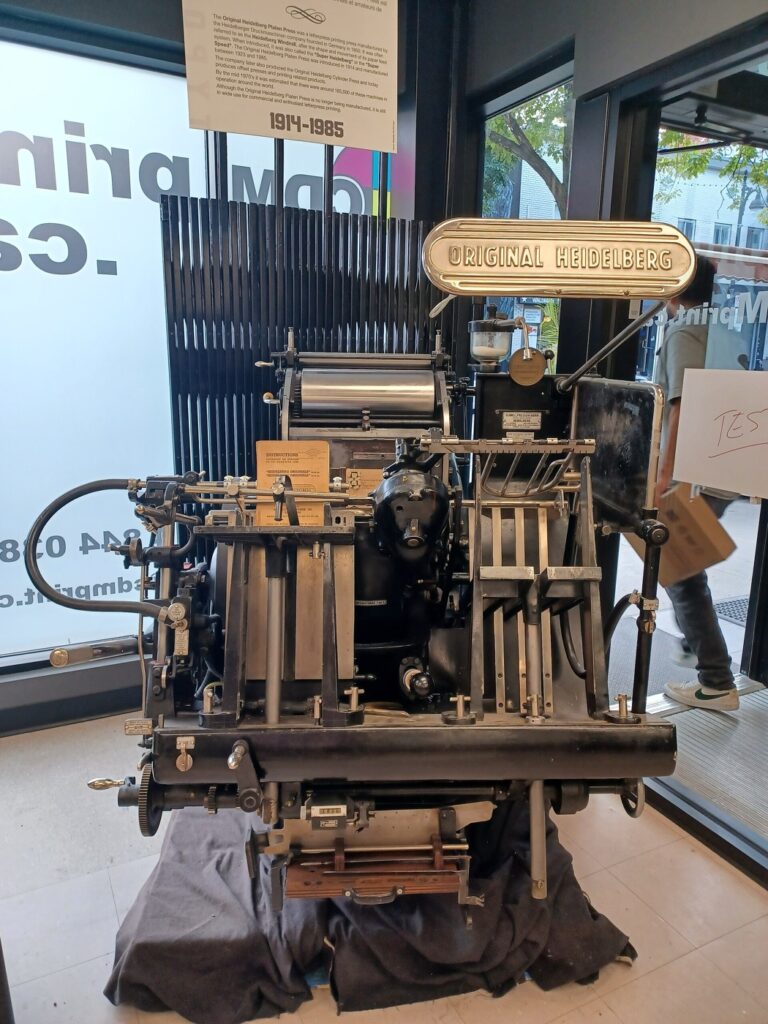
Original Heidelberg platen press. Photo: Ineuw. Wikimedia Commons (CC0).
1914
The Heidelberg Windmill
In 1914 Heidelberg introduced its Original Platen press, nicknamed the Windmill for the spinning arms that feed and deliver each sheet. It became one of the most popular printing presses ever built, and many are still working today for letterpress, die cutting, foiling, creasing and numbering.
Today
Digital printing, right here in Noosa
Digital presses print straight from your PDF, with no plates to make, so short runs, quick turnarounds and personalised printing are fast and affordable. The tools have changed, but the craft hasn’t: good paper, accurate colour and careful finishing. We’ve been printing for Noosa since 1977, and we’re proud to be a small part of this long story.
Part of the story since 1977.
Send us your artwork or tell us what you need, and we’ll print it with the same care printers have taken for centuries.